Architect of the Dubai Virtual Map — the first interactive, intelligent, vector-based GIS land information system of its kind across the Middle East, Africa, and Asia (including India). Built from the ground up. Recognised by 7 global platforms. A decade completed by design.
In 2001, Dr. Senthil was working with Omnix International, representing Autodesk products across the Middle East. He travelled to Switzerland for what appeared to be a MapGuide training programme. It turned out to be a rigorous global evaluation.
Out of many participants, only four were selected and certified. He returned as the only MapGuide-accredited professional in the entire Middle East at that time — a credential held by no one else across the region, Africa, or Asia.
He presented the solution to clients across the Middle East, including a live demonstration to royalty in Bahrain. When he presented to the Dubai Land Department, he expected a product sale.
The Department had other plans. They did not want the product. They wanted him. The Department decided to build the system entirely in-house — their land data was too sensitive to be handled externally. He joined on February 5, 2001 — no appointment letter, no contract.
"I will implement the project in 3 to 6 months and go back to marketing."
— His thought on joining · February 5, 2001From 1992 to 2001 he was in marketing. Returning meant restarting every technical discipline simultaneously — while building a live government system with no safety net.
Learn at night. Implement in the morning.
Day after day. For one and a half years.
No job security. No guarantee. Only one thing: completion.
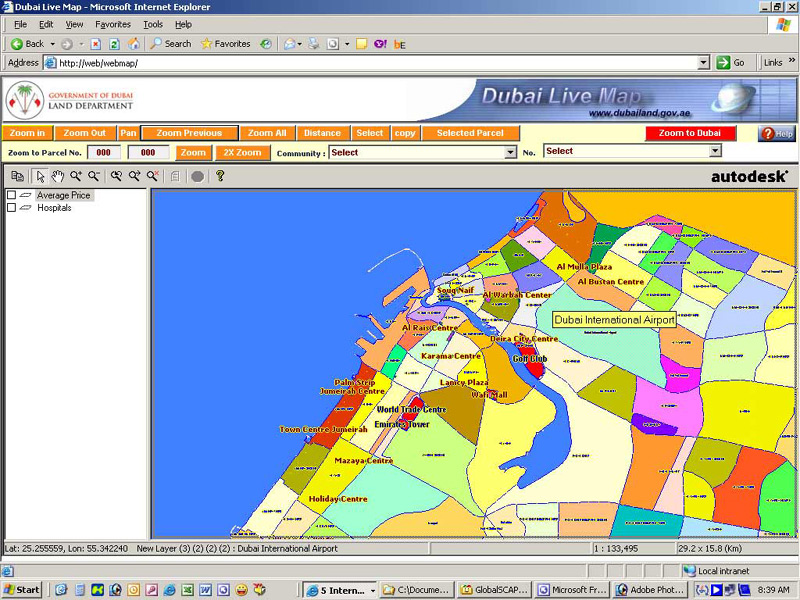
As published in Gulf News, October 12, 2002. The map screenshot used by journalist Tanya Goudsouzian to illustrate her feature article — showing the Deira creek area with individual parcels color-coded. Seen by hundreds of thousands of UAE readers the day before the official GITEX launch.
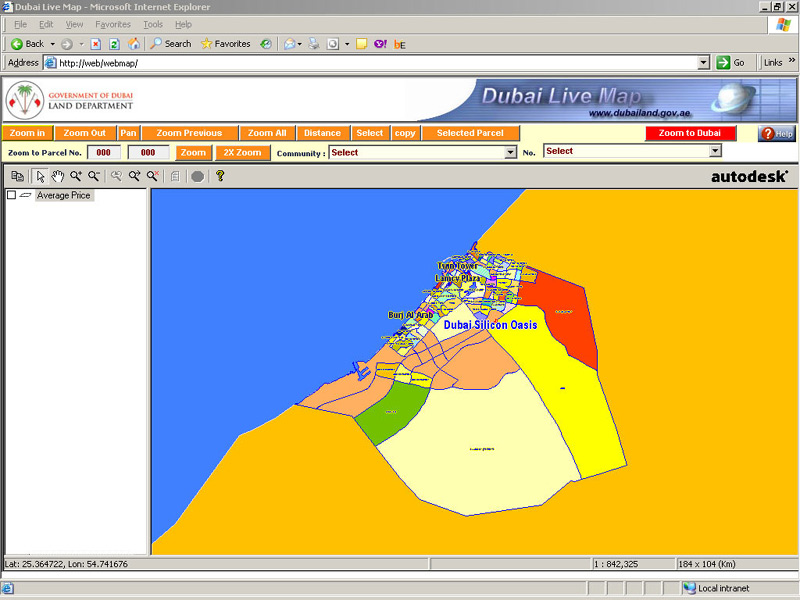
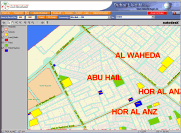
The exact screenshot published to 29,000+ geospatial professionals worldwide in the SpatialNews Daily NewsWire. Shows Abu Hail, Al Waheda, Hor Al Anz with individual parcels and MapGuide toolbar active.
Microstation drawings converted to intelligent GIS topology via AutoCAD Map · Coordinate projection transformation applied · Entire system built and maintained in-house · Second project: File Movement & Workflow System built using ASP, ODBC, JavaScript, HTML
"This is an intelligent object combining graphics with database information. It gives you the special number allocated to any given parcel of land, it calculates the distance from here to there, and it can take you to the website of the plot owner."— E. Senthil Kumaran, Project Manager · Gulf News, October 12, 2002 · Demonstrating live to journalist Tanya Goudsouzian
"By providing the searching power directly to the public, enabling anyone with Web access to research areas and find parcel locations themselves, the LD's staff is now able to dedicate more time to their primary business tasks."— E. Senthil Kumaran, Project Manager – GIS Web Publishing · Autodesk Customer Success Story · © 2003 Autodesk Inc., San Rafael, California USA
Within weeks of its GITEX 2002 launch, the Dubai Virtual Map received recognition from seven international platforms — a global technology corporation, the UAE's flagship English newspaper, and five specialist geospatial publications reaching tens of thousands of professionals worldwide.
It is now possible for landowners or real estate brokers to locate their property in Dubai by double-clicking on a virtual map, courtesy Land Department. This revolutionary service, linked to www.dubailand.gov.ae, will be launched in time for GITEX 2002 on October 13.
The Land Information System was used internally for a few months to ensure its efficiency. E. Senthil Kumaran, Project Manager, demonstrated how LIS merges a conventional map of the emirate with data such as distance, nearby monuments, and prices.
There are more than 80,000 parcels in the emirate. Kumaran managed to devise a programme which automated the process of inputting all the requisite data. The system is superimposed on a world atlas. The Department has detailed information on 45,993 landowners and 49,302 plots of land all over the emirate.
Published as an official Customer Success Story by Autodesk Inc. — global leader in design software. The case study describes the Dubai Guide Map as "a revolutionary MapGuide application for not only Dubai but for the whole UAE" and the Land Department as "the technological jewel of Dubai's governing crown."
Dr. Senthil is named: "E. Senthil Kumaran, Project Manager – GIS Web Publishing, Dubai Land Department" — the sole technical architect credited. Published in both English and Arabic.
The Dubai Virtual Map grew far beyond its original mandate. Government departments, commercial organisations, and major city initiatives all adopted it as their shared spatial intelligence platform. During this same period, the Dubai Land Department won 1st place for best services among all Dubai Government departments — three consecutive years.
Two public kiosk machines were installed on the ground floor of the Dubai Land Department. Citizens could walk in, enter a parcel number, and — for the very first time in their lives — see their land on a screen.
Before this, a person had to request a paper map, wait for a draftsman to search archives, have it copied, and come back. The kiosk ended that entirely.
This was not just one map project. Dr. Senthil was centrally involved in the computerisation of the entire Dubai Land Department — in direct alignment with the Government of Dubai's E-Government services initiative.
During Dr. Senthil's tenure, the Dubai Land Department was ranked 1st among all Dubai Government departments for service excellence — for three consecutive years.
The computerisation programme he led — the Virtual Map, the Workflow System, the Kiosk System, the E-Government alignment — was a direct contributor to this achievement. The institution was rewarded. And so was he personally, with the Excellence Award.
In 2006, Dr. Senthil was selected to conduct training for the UAE's most gifted students — those recognised under the Hamdan Bin Rashid Al Maktoum Foundation for Distinguished Academic Performance.
These were the top 1% of students in the country — the Hamdan Award winners. A formal National Plan to bridge academic brilliance with professional technical skills.
He was not just teaching IT. He was showing them how the digital architecture of a city is built — from someone who had actually built it. Many went on to become the engineers and urban planners driving the UAE's smart city initiatives today.
He entered thinking it was temporary — a project of three to six months. He stayed for a decade. He built something that worked, scaled, received global recognition, and became part of a city's transformation. And then, on exactly the same date he had joined ten years before — a date he had chosen six months in advance — he left. Not because he had to. Because he was ready.